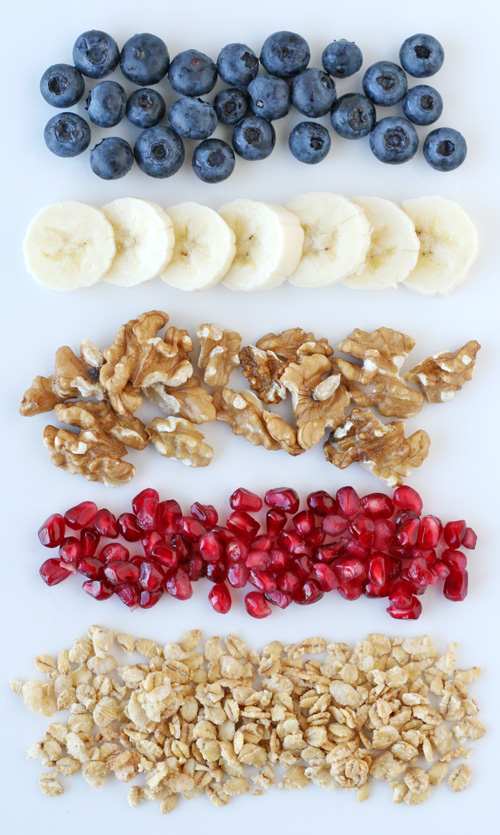
I’ve almost always loved yogurt: first the sickly sweet kind laden with chunky fruit, then the whipped kind, and the custard kind. Soon after starting my weight loss journey, I took on Greek yogurt, and I’ve never looked back. I have to be adaptable on what brand I buy, but even so, I have favorites. Fage undoubtedly has my favorite fruit flavors. Light N Fit Greek is only 80 calories per cup and makes a few fantastic chocolaty flavors. But even buying them at $1 a cup on sale, it can get pricey. Plus, a lot of my favorite flavors are loaded with sugar. My solution? Buying large tubs of plain and topping them myself!
Plain Fage Greek yogurt is just 130 calories per cup and boasts around 24 grams of protein. If you can tolerate the taste plain, go for it! For me, it’s just a little bit too tart. I also find that half a cup of yogurt with a little bit of topping satisfies me for quite a while, so each of the following combinations is designed for adding to a half cup serving of yogurt.
In Part I, Part II and Part III of this series, I’ve addressed knowing what you consume, drinking more water, and cutting back on your calories. But one of the weight loss mantras is “eat less, move more”, right? Depending on your weight and level of fitness, you may not want to jump right into hardcore exercise. I certainly didn’t. I hated exercise. The word exercise sent shivers down my spine! My favorite activities were sedentary: reading, writing, playing video games, going to the movies and watching television. My job was also largely sedentary. If you’re at all familiar with Sir Isaac Newton and his notorious First Law of Motion, you’ll know that bodies in motion tend to stay in motion and bodies at rest tend to stay at rest. (Proof that amazing hair and brilliance go hand in hand!)
Dayum, gurl, you been usin’ Pantene?
So if you’re like me, unwilling to spend money you don’t have on a gym membership, you need to come up with solutions to move more while spending as little as possible. As is always the case with me, I started small. When I used to visit my family doctor, I would take the elevator. To the SECOND FLOOR. I started taking the stairs. Instead of using the escalator when I go to the mall, I now go out of my way to take the stairs. I park farther away from the store when I go shopping as well, sometimes even on the opposite end of the mall. I walk from where I parked, across the entire mall, get what I need, then walk back. My doctor even suggested I go to a Super Walmart and do laps around the store in the winter months. The possibilities are almost endless: a quick Google search for free exercises lead me to this fabulous entry from Broke and Healthy – 100 Free or Cheap Ways to Exercise.
Early on, I did cardio exercise videos in front of my computer, or jogged in place while I watched television at night. In the warmer months, I found a training program for a 5K, and trained for that. There are even apps that can help you train for a 5K, like the Couch-to-5k App. I have a desk job for the most part, but things have changed at work, too. I now walk the packages to mail out to the pick-up spot in the front of the store instead of asking someone to do it for me. I bring my dog to work and walk him at least twice around the block during the day. At times, I even do 5-minute Tabata breaks (this works better in the summer when I’m not wearing snow boots). When I’m asked to go something at the bank, I walk. It’s only ⅓ of a mile each way. When I get coffee, I walk. When I go to the post office, I walk. Seeing a trend? MOVE MORE. It doesn’t have to feel like exercise to be helpful.
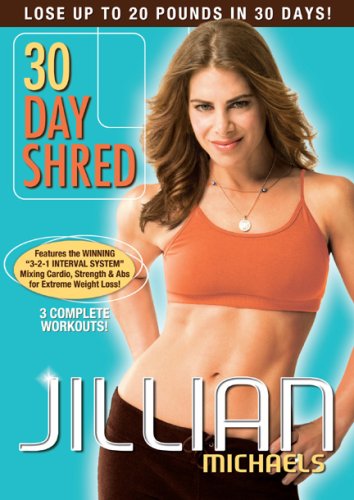
As I lost weight and felt better, I tried new exercise videos. Amazon had a sale: Jillian Michaels’ 30 Day Shred for only $5 on digital video. I could watch it on my PS3, and all I needed were hand weights! I had heard Jillian was a tough trainer, but to be honest, I hadn’t a CLUE how tough that workout would be. I modified at first, then finally
She still terrifies me. *shudder*
made it through stage 1. I did the workout, but soon found myself DREADING it. Jillian is no joke. I forced myself to continue the 30 Day Shred every other day, but it was just that: forced. Soon, my decision was made for me. One day, while doing the video, I stood up from the ab section to switch to jumping jacks, and I got tunnel vision and felt like I was going to throw up. I sat down on the couch and checked my blood pressure. It was 90/69. I was on water pills (hydrochlorothiazide) to manage pre-hypertension, but suddenly my blood pressure was LOW. With my doctor’s approval, I quit the water pills AND Jillian Michaels for good.
I continued to try various workout videos, but the only thing I really loved doing was walking outside. So the summer of 2012 was spent doing just that: enjoying the summertime, the trees, and nature. The cardio you get from brisk walking is great, and cardio is very important for shedding fat. I dabbled in weight training with hand weights but it bored me. It wasn’t until after I hit my goal weight in August 2014, that I found my exercise true love, kettlebells. Since I started working out with kettlebells in early September 2014, I haven’t missed a single workout. I do kettlebells three times a week without fail, because I love them.
So, seriously, you know what I’m going to say, don’t you? Find what you love to do, and DO IT. Move more, get out in the sunshine, and feel good!
Spinach is totally a weird choice for carbohydrates.
Okay, if you use a website or app to track your food, or you hang out with low-carbers or weight lifters, like you do, you’ve probably heard the word “macros” tossed around once or twice. (As you play this weight-loss game/journey to health you’ll find your vocabulary changes. I suddenly know the names of a lot more body parts than I used to. Now I need to figure out how to use “clavicle” in a game of Scrabble!) So what the *BLEEP* are MACROS, anyway?!
Macronutrients, or Macros for short, are nutrients that provide calories or energy for the body to burn. Depending on the source, there are either 3 or 4 types of macronutrients: protein, fat, carbohydrates and, occasionally, alcohol. For the purpose of diet (and I mean diet as in the food you need to survive, not a diet, as in cutting calories), I’m going to skip alcohol, as it isn’t necessary for the human body to live. Protein, fat and carbohydrates are all vital to the normal, everyday functioning of the human body.
Protein might be the only of the three macronutrients that doesn’t get a lot of negative press. I mean, they sell giant jars of PROTEIN POWDER. (One has been sitting on top of my fridge for almost a year now.) People are encouraged to increase protein intake on a regular basis. Protein is the “cool” macronutrient. Protein is essential for growth: our bodies convert protein to amino acids which (if you recall from high school biology) are the building blocks of life.
Thousands of vegetarians and vegans are crying out in terror right now.
Protein also helps our bodies produce hormones, repair tissue (really important for strength training), bolster the immune system, and preserve lean muscle mass. Animal sources of protein are complete proteins, containing all the required amino acids, while vegetarian sources of protein are incomplete proteins, so vegans and vegetarians usually require additional supplements to account for the missing amino acids. The USDA recommends 10-35% of daily calorie intake should come from protein, and protein is 4 calories per gram.
Fat is by far the most maligned of the macronutrient family, but it’s only specific fats that are considered detrimental to our health. Saturated and Trans Fats (perhaps you’ve heard of this scamp being removed from foods around the United States) increase your risk for heart disease, but unsaturated fats can help reduce your risk of heart disease. Fat is the most dense source of energy, contributes to satiety, helps maintain cell membranes, provides cushioning to internal organs, and helps the body absorb certain vitamins. Plus, as chefs say, fat is flavor! The USDA recommends 20-35% of daily calorie intake
Healthy fats! (Yes butter is acceptable in moderation, dang it!)
should come from fat, and fat is 9 calories per gram.
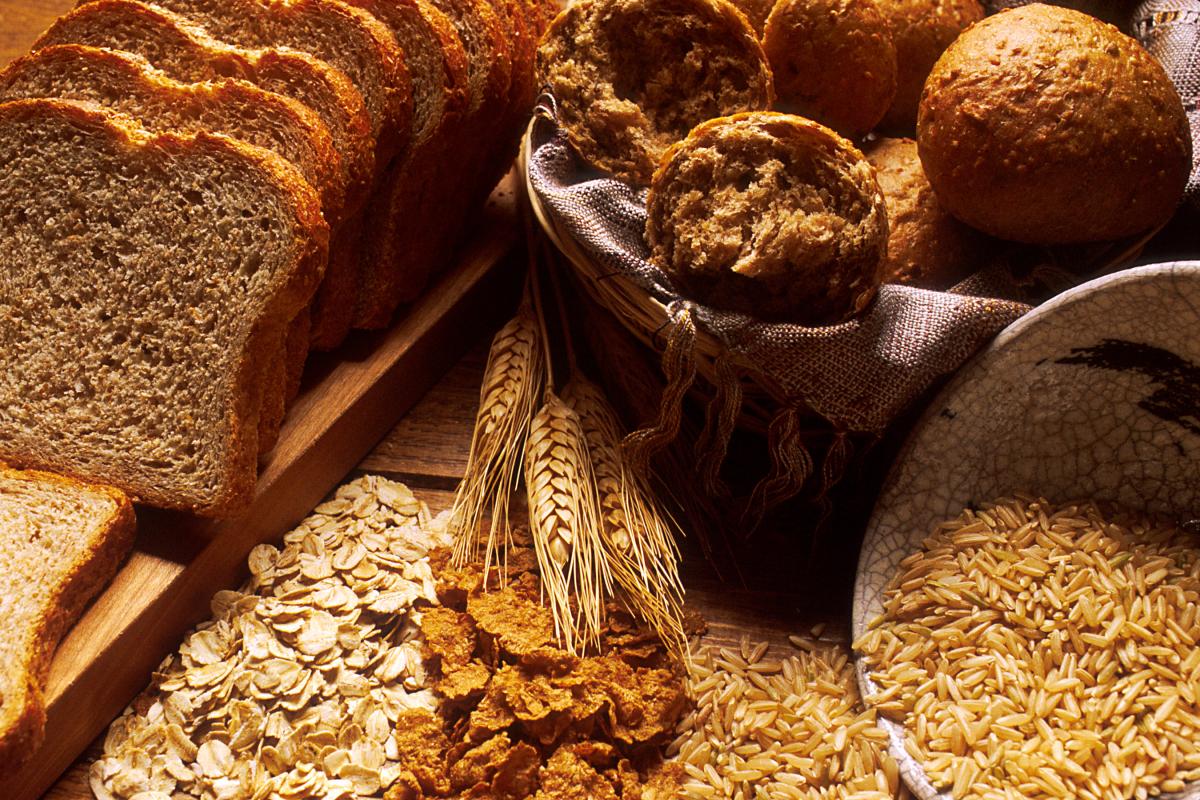
Carbohydrates often get a bad rep, like fat. There are a lot of buzz words floating around lately: low-carb, slow-carb, net carbs. Despite what proponents of low carb dieting might want you to believe, carbohydrates are the macronutrients the body requires most. According to the USDA, 45-65% of daily calorie intake should come from carbs. Carbs are easily converted to glucose by the body, which is the main source of fuel. Without carbs, our kidneys, brain, muscles (heart included) and the central nervous system would all cease to function. Carbs are important for a whole host of other reasons, but the long and short of it is that we need them. Carbohydrates are 4 calories per gram.
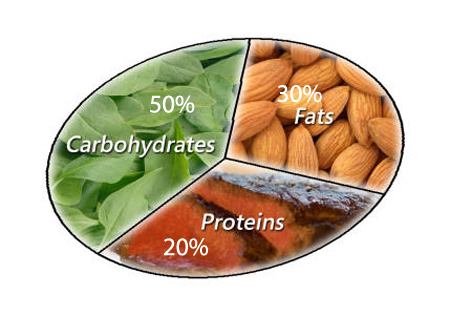
So now that we know what macros are, what do we DO with them? Well, how you tweak your macro ratios is highly individual. I personally have been using 20/30/50 protein/fat/carb ratio. Why? Well, to be totally honest, it’s what’s recommended on SparkPeople.com and that’s where I track my food. I don’t do low carb, and it seems to work for me. It assures me that I’m getting enough protein to support my weight training, and that I’m keeping my carbs and
Almost everyone’s nemesis: delicious, delicious carbs!
fat in check. The quality of your carbs and fat is, ultimately, up to you. If you’re low-carb, you’re going to be eating more fat and protein compared to carbs. Human beings are pretty flexible, so as long as you stay within the numbers recommended by the USDA, you should get all the vital nutrients you need for good health, barring any medical conditions that might inhibit nutrient absorption.
Just as always, you need to do what works for you. If you prefer low-carb or paleo, do that. If you prefer to just eat real food and not worry about excluding things, do that. Pick a set of ratios and try it out, but feel free to tweak slightly. The truth is, there is no one answer. (Sorry!) I personally try to cook from scratch several nights per week, but I don’t cut out processed food for snacks if that’s what I want. I generally eat homemade food 80% of the time and other foods 20% of the time, and so far, it’s worked for me, because life isn’t perfection. Nobody’s perfect, and you shouldn’t try to *be* perfect, because this sets you up for failure.


 I’ve almost always loved yogurt: first the sickly sweet kind laden with chunky fruit, then the whipped kind, and the custard kind. Soon after starting my weight loss journey, I took on Greek yogurt, and I’ve never looked back. I have to be adaptable on what brand I buy, but even so, I have favorites. Fage undoubtedly has my favorite fruit flavors. Light N Fit Greek is only 80 calories per cup and makes a few fantastic chocolaty flavors. But even buying them at $1 a cup on sale, it can get pricey. Plus, a lot of my favorite flavors are loaded with sugar. My solution? Buying large tubs of plain and topping them myself!





 A Measured Life