How to Lose 100 Lbs Without Losing Your Mind or Breaking the Bank: Part IV – Move More

http://www.undomestic-mama.com/2012/02/working-out.html

In Part I, Part II and Part III of this series, I’ve addressed knowing what you consume, drinking more water, and cutting back on your calories. But one of the weight loss mantras is “eat less, move more”, right? Depending on your weight and level of fitness, you may not want to jump right into hardcore exercise. I certainly didn’t. I hated exercise. The word exercise sent shivers down my spine! My favorite activities were sedentary: reading, writing, playing video games, going to the movies and watching television. My job was also largely sedentary. If you’re at all familiar with Sir Isaac Newton and his notorious First Law of Motion, you’ll know that bodies in motion tend to stay in motion and bodies at rest tend to stay at rest. (Proof that amazing hair and brilliance go hand in hand!)

Dayum, gurl, you been usin’ Pantene?

So if you’re like me, unwilling to spend money you don’t have on a gym membership, you need to come up with solutions to move more while spending as little as possible. As is always the case with me, I started small. When I used to visit my family doctor, I would take the elevator. To the SECOND FLOOR. I started taking the stairs. Instead of using the escalator when I go to the mall, I now go out of my way to take the stairs. I park farther away from the store when I go shopping as well, sometimes even on the opposite end of the mall. I walk from where I parked, across the entire mall, get what I need, then walk back. My doctor even suggested I go to a Super Walmart and do laps around the store in the winter months. The possibilities are almost endless: a quick Google search for free exercises lead me to this fabulous entry from Broke and Healthy – 100 Free or Cheap Ways to Exercise.

Early on, I did cardio exercise videos in front of my computer, or jogged in place while I watched television at night. In the warmer months, I found a training program for a 5K, and trained for that. There are even apps that can help you train for a 5K, like the Couch-to-5k App. I have a desk job for the most part, but things have changed at work, too. I now walk the packages to mail out to the pick-up spot in the front of the store instead of asking someone to do it for me. I bring my dog to work and walk him at least twice around the block during the day. At times, I even do 5-minute Tabata breaks (this works better in the summer when I’m not wearing snow boots). When I’m asked to go something at the bank, I walk. It’s only ⅓ of a mile each way. When I get coffee, I walk. When I go to the post office, I walk. Seeing a trend? MOVE MORE. It doesn’t have to feel like exercise to be helpful.

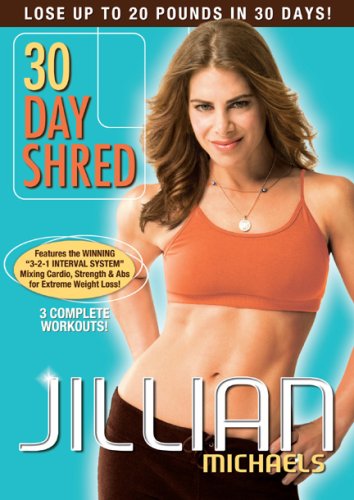
As I lost weight and felt better, I tried new exercise videos. Amazon had a sale: Jillian Michaels’ 30 Day Shred for only $5 on digital video. I could watch it on my PS3, and all I needed were hand weights! I had heard Jillian was a tough trainer, but to be honest, I hadn’t a CLUE how tough that workout would be. I modified at first, then finally
http://www.amazon.com/Jillian-Michaels-30-Day-Shred/dp/B00127RAJY
She still terrifies me. *shudder*

made it through stage 1. I did the workout, but soon found myself DREADING it. Jillian is no joke. I forced myself to continue the 30 Day Shred every other day, but it was just that: forced. Soon, my decision was made for me. One day, while doing the video, I stood up from the ab section to switch to jumping jacks, and I got tunnel vision and felt like I was going to throw up. I sat down on the couch and checked my blood pressure. It was 90/69. I was on water pills (hydrochlorothiazide) to manage pre-hypertension, but suddenly my blood pressure was LOW. With my doctor’s approval, I quit the water pills AND Jillian Michaels for good.

I continued to try various workout videos, but the only thing I really loved doing was walking outside. So the summer of 2012 was spent doing just that: enjoying the summertime, the trees, and nature. The cardio you get from brisk walking is great, and cardio is very important for shedding fat. I dabbled in weight training with hand weights but it bored me. It wasn’t until after I hit my goal weight in August 2014, that I found my exercise true love, kettlebells. Since I started working out with kettlebells in early September 2014, I haven’t missed a single workout. I do kettlebells three times a week without fail, because I love them.

So, seriously, you know what I’m going to say, don’t you? Find what you love to do, and DO IT. Move more, get out in the sunshine, and feel good! 
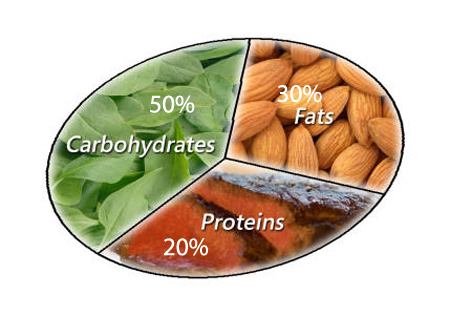
What the *BLEEP* Are MACROS?!

http://weightlossandme.com/macronutrients-affect-workout/
Spinach is totally a weird choice for carbohydrates.

Okay, if you use a website or app to track your food, or you hang out with low-carbers or weight lifters, like you do, you’ve probably heard the word “macros” tossed around once or twice. (As you play this weight-loss game/journey to health you’ll find your vocabulary changes. I suddenly know the names of a lot more body parts than I used to. Now I need to figure out how to use “clavicle” in a game of Scrabble!) So what the *BLEEP* are MACROS, anyway?!

Macronutrients, or Macros for short, are nutrients that provide calories or energy for the body to burn. Depending on the source, there are either 3 or 4 types of macronutrients: protein, fat, carbohydrates and, occasionally, alcohol. For the purpose of diet (and I mean diet as in the food you need to survive, not a diet, as in cutting calories), I’m going to skip alcohol, as it isn’t necessary for the human body to live. Protein, fat and carbohydrates are all vital to the normal, everyday functioning of the human body.

Protein might be the only of the three macronutrients that doesn’t get a lot of negative press. I mean, they sell giant jars of PROTEIN POWDER. (One has been sitting on top of my fridge for almost a year now.) People are encouraged to increase protein intake on a regular basis. Protein is the “cool” macronutrient. Protein is essential for growth: our bodies convert protein to amino acids which (if you recall from high school biology) are the building blocks of life.

http://bretcontreras.com/how-much-protein-do-you-really-need/
Thousands of vegetarians and vegans are crying out in terror right now.

Protein also helps our bodies produce hormones, repair tissue (really important for strength training), bolster the immune system, and preserve lean muscle mass. Animal sources of protein are complete proteins, containing all the required amino acids, while vegetarian sources of protein are incomplete proteins, so vegans and vegetarians usually require additional supplements to account for the missing amino acids. The USDA recommends 10-35% of daily calorie intake should come from protein, and protein is 4 calories per gram.

Fat is by far the most maligned of the macronutrient family, but it’s only specific fats that are considered detrimental to our health. Saturated and Trans Fats (perhaps you’ve heard of this scamp being removed from foods around the United States) increase your risk for heart disease, but unsaturated fats can help reduce your risk of heart disease. Fat is the most dense source of energy, contributes to satiety, helps maintain cell membranes, provides cushioning to internal organs, and helps the body absorb certain vitamins. Plus, as chefs say, fat is flavor! The USDA recommends 20-35% of daily calorie intake

http://www.womenshealthmag.com/nutrition/good-fat-facts
Healthy fats! (Yes butter is acceptable in moderation, dang it!)

should come from fat, and fat is 9 calories per gram.

Carbohydrates often get a bad rep, like fat. There are a lot of buzz words floating around lately: low-carb, slow-carb, net carbs. Despite what proponents of low carb dieting might want you to believe, carbohydrates are the macronutrients the body requires most. According to the USDA, 45-65% of daily calorie intake should come from carbs. Carbs are easily converted to glucose by the body, which is the main source of fuel. Without carbs, our kidneys, brain, muscles (heart included) and the central nervous system would all cease to function. Carbs are important for a whole host of other reasons, but the long and short of it is that we need them. Carbohydrates are 4 calories per gram.

So now that we know what macros are, what do we DO with them? Well, how you tweak your macro ratios is highly individual. I personally have been using 20/30/50 protein/fat/carb ratio. Why? Well, to be totally honest, it’s what’s recommended on SparkPeople.com and that’s where I track my food. I don’t do low carb, and it seems to work for me. It assures me that I’m getting enough protein to support my weight training, and that I’m keeping my carbs and

http://www.dfitpt.com/carbohydrates-exposed#.VMbmLVWJOuY
Almost everyone’s nemesis: delicious, delicious carbs!

fat in check. The quality of your carbs and fat is, ultimately, up to you. If you’re low-carb, you’re going to be eating more fat and protein compared to carbs. Human beings are pretty flexible, so as long as you stay within the numbers recommended by the USDA, you should get all the vital nutrients you need for good health, barring any medical conditions that might inhibit nutrient absorption.

Just as always, you need to do what works for you. If you prefer low-carb or paleo, do that. If you prefer to just eat real food and not worry about excluding things, do that. Pick a set of ratios and try it out, but feel free to tweak slightly. The truth is, there is no one answer. (Sorry!) I personally try to cook from scratch several nights per week, but I don’t cut out processed food for snacks if that’s what I want. I generally eat homemade food 80% of the time and other foods 20% of the time, and so far, it’s worked for me, because life isn’t perfection. Nobody’s perfect, and you shouldn’t try to *be* perfect, because this sets you up for failure.

Go out there, be good, and do what works for you!

Want more info? Check out the USDA and McKinley Health Center.

Vitamin D: Are You Deficient?

From http://nutristart.com/vitamin-d-foods/

NOTE: I am not a doctor and you should never take any supplements without first consulting your doctor.

If you get outside a lot, or drink milk regularly, you probably don’t think much about Vitamin D. Vitamin D is a crucial vitamin whose main purpose is to help your body use calcium to build strong bones. Lack of Vitamin D can cause a whole host of problems, many of which aren’t obviously related to the source of the problem. In fact, symptoms of Vitamin D deficiency can be mistaken for a thousand other problems.

In the summer of 2009, I was around 275 lbs. The Hubs and I were both unemployed, but we were newlyweds, and we had my Dad nearby for support, both emotional and financial. Things were okay, not great, but okay. But it was summertime, and I was depressed. Not normal, I’m-having-a-rough-time-right-now-but-things-will-get-better depressed, but more serious, lay-on-the-couch-in-tears-staring-into-space depressed. I’d had depression before, when someone very close to me had died, and this was far worse. I’d known that I was susceptible to feeling down on rainy days, and that I felt better on sunny days. But it was summer, warm, wonderful, sunshiny summer! So why did I feel so lousy?

On top of the depressions, I had other symptoms. I ached, physically. It started with my shoulder, my left shoulder. It ached for seemingly no reason. The next day would roll by and the pain would be in my left elbow. Then my left wrist. I wasn’t sure if I’d injured myself or not. It started to worry me. But one day, the aches moved. To my other arm. That really freaked me out. I sucked it up and went to the doctor. The depression concerned him, but the migrating pain concerned him more. He asked that I have a full blood test done. And what that revealed was surprising. My Vitamin D level was 11. Well, 11 what? Turns out, it’s 11 ng/ml (or nanograms per milliliter).

This may seem like an arbitrary number: it certainly seemed like that to me. But my doctor said that research into Vitamin D’s importance was being re-evaluated. Previously, a level of 32 ng/ml was considered sufficient for the body to properly utilize calcium, but when I was suffering from deficiency, doctors were about to raise the level to 45 ng/ml. A quick bit of research while writing this entry revealed that the desired level is now 50 ng/ml. So I had a FIFTH of the desired Vitamin D in my system. It was causing my depression and my bone pain, and if I’d let it go much further, I could get rickets. Vitamin D deficiency is also associated with the following:

  • Muscle Weakness
  • Increased risk of cardiovascular disease
  • Cognitive impairment in older adults
  • Severe asthma in children
  • Cancer

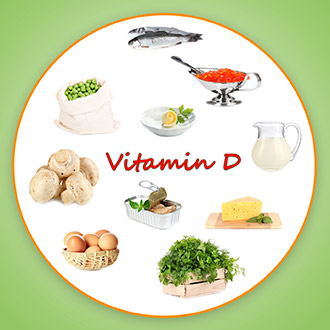
So what causes this deficiency? Diet is one of the causes. If you’re a vegan, or have a milk allergy, you might not be getting enough dietary vitamin D, because most of the natural sources of vitamin D are animal based: fish and fish oils, fortified milk, egg yolks, cheese and beef liver. You also may not be getting enough sun exposure. Those with darker skin have a harder time absorbing the sun’s rays, and sun exposure helps our bodies naturally produce vitamin D. That’s why a deficiency may have stronger symptoms in winter, when the sun rises late and sets early. You could be older: as we age, our kidneys are less capable of converting vitamin D to its active form. Digestive issues are also a problem: if you have Crohn’s disease, celiac or cystic fibrosis, your intestines may not be able to adequately absorb vitamin D. Lastly, obesity can be a cause. Fat cells can pull vitamin D from the blood, inhibiting its release into the circulatory system. Those with a Body Mass Index over 30 can have low blood vitamin D.

From: http://bestvitamindsupplement.net/the-best-vitamin-d-supplement-for-men-risks-benefits/

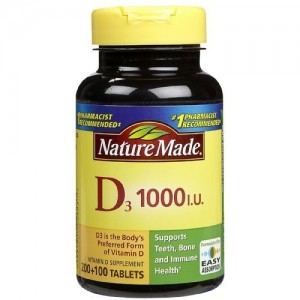
The best thing to do if you suspect you have low Vitamin D levels is to make an appointment with your doctor to have a blood test. If your blood test results show low Vitamin D, your doctor may prescribe you high dosage Vitamin D pills. I was given a 12-week regimen of 50,000 IUs a week, and let me tell you, after the second pill, I felt almost normal again. Since the prescription ran out, my doctor has had me taking 5,000 IUs a day. And to be honest, even with that, I still get the winter blues. So I invested in light therapy for the winter months. I use what’s called a HappyLight: a natural light spectrum lamp you can use first thing in my morning for 20-30 minutes to help your body produce Vitamin D naturally. It really improves my mood in the winter months, and I find I don’t need it in the summer at all.

Vitamin D deficiency can cause a LOT of very serious problems, but the good news is that if you catch it, it’s easy to fix. (My prescription Vitamin D cost less than $10, and over the counter Vitamin D is less than $10 for 250 pills.) Remember, your health is more than your weight!

You can find more information about Vitamin D deficiency at WebMD and The Vitamin D Council.