So you have a workout routine. Maybe you’ve even done a couple of the ones I’ve shared on here. You’ve heard the phrases “warm up” and “cool down” and “static” and “dynamic stretching”, but you’re not sure what the difference is. I can help you with that!
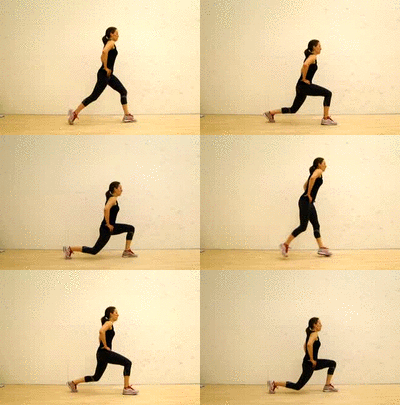
Dynamic stretching is the act of moving your muscles to loosen them up while the body is in motion. It’s meant to warm up the muscles and lengthen them in order to prepare your body for exercise and prevent injury. It also loosens the joints. Dynamic stretching should be done before your workout. Examples of dynamic stretching include:
Static stretching is slow, focused movements intended to loosen the muscles while the body is at rest. It’s better to do these sorts of stretches AFTER a work out, as you’re trying to cool your body down. Static stretching is great for reducing DOMS (delayed onset muscle soreness) and preventing muscle stiffness and thus injury later on. Examples of static stretching include:
I hope this brief guide helped you figure out the difference between dynamic and static stretching and when to use which! Take care of your body to avoid injury, it’s the only one you have!
So I talk about kettlebells a lot. I’m well aware I have a bit of a problem. The Hubs may have thrown around the word “obsessed”, but this is simply not true. I am a measured lady, and obsession just isn’t me. (Binge watching 7 seasons of Parks & Recreation in less than 2 weeks totally doesn’t count, people!) So to prove this, I’m going to write about some other popular exercises you may have heard of, and may or may not be curious about. Some of these I’ve tried (at home, via DVD) and some I have not.
Barre
Barre classes are inspired by ballet and also utilize yoga and pilates. The barre (a waist-level horizontal bar used for support) is used to balance while performing exercises that focus on isometric strength training (holding still while focusing on one muscle set). Barre involves high reps with a small range of motion. A barre class may also involves light hand weights or mat work. Barre is great for busy women, because it’s a well-rounded exercise program in a short period of time. It’s also great for posture, and it’s low-impact, so it’s great for pregnant women. It combines strength training (mostly bodyweight) and cardio to burn fat and build lean muscle. Think dancer’s body. (I’ve done a Barre routine at home, and it’s no joke. It’s not a work-up-a-sweat workout, but I felt it the next day.)
Yoga
Said to be for the purpose of uniting the mind, body and spirit, practicing yoga involves meditation, stretching and building strength. Yoga also helps the participant develop increased flexibility through the performance of poses or postures that can be done quickly in succession to warm the body or slowly to perfect alignment of the pose and increase stamina. Yoga is great for people of all ages and fitness levels, as it can be very gentle. Types of yoga vary greatly, and some may delve more deeply into the spiritual side than others. Yoga can be added to a more intense workout routine for relaxation and to soothe tight muscles. (The Hubs does yoga moves on the Wii Fit. He seems to really like it.)
Pilates
The foundation of Pilates (named after inventor Joseph Pilates to rehabilitate prisoners of war) is core strength, and the core supports the spine. Pilates is great for helping people overcome back pain by stabilizing the spine and relieving pressure on the back. Centering, control, flow, breath, precision and concentration are the six Pilates principles and Pilates focuses on low repetitions, preferring quality of movement over quantity. Pilates is a great addition to other forms of exercise, helping improve other types of exercises and sports. Pilates exercises are usually done directly on the floor or on a mat, and occasionally special equipment involving springs and pulleys. (Pilates IS NO JOKE. It’s sneakily difficult, and you will feel it in your core the next day. I did Mari Winsor Pilates way back when, and I still have the DVDs around here somewhere.)
Do you love dancing? Zumba is based on combining high energy Latin and international music with fun dance moves. Purely aerobic, routines combine interval training and resistance training. Types of dance include hip-hop, soca, samba, salsa, merengue and mambo, and squats and lunges are also incorporated. There are different levels of Zumba classes, which special Zumba Gold classes aimed specifically at the elderly. If you like your workouts to feel like a huge dance party, then Zumba might just be for you!
Spinning classes are a great way to keep your muscles in shape, especially if you love biking. Attendees sit on an exercise bike and an instructor guides them through the workout phases: warm-up, steady uptempo cadences, sprints, climbs, cool-downs, etc. The attendees control their own resistance to get the level of effort they like. Switching between sitting and standing while pedaling as well as varying speed keeps the workout varied and interesting, but it’s up to the individual to really put in the effort to sweat.
Classes for all of these workouts are available at many gyms, but as you can see, you can try them in the privacy of your own home, if you prefer to avoid the company of others while you’re panting and sweaty. If you know what I mean.
Abs. Why do we think we have to spend hours doing a thousand different types of crunches in order to get ab definition? That sounds like some sort of crazy self-induced torture to me. If I haven’t mentioned it before, I’m LAZY. Many people I know would argue with me on this: I’ve dedicated the last several years of my life to getting healthy while spending as little as possible to do so. I work full time, do bookkeeping on the side, write this blog, volunteer at a local animal shelter, cook 6-7 days a week, and still don’t feel like I’m busy enough! Even so, spending more than 15 minutes focusing solely on ab work just sounds like a colossal waste of time to me. Worse yet: it sounds BORING.
Kettlebells and planks, my friends.
Granted, my kettlebell workouts involve a lot of core work, so if you’re doing only cardio and hand weights, you might need to adjust the time spent on ab work. I, personally, do about 15 minutes worth of abs twice a week on Mondays and Wednesday. Fridays my kettlebell workout video involves more core work, so I skip abs that day. The most important exercise I do? Planks. Planks SUCK. And by that I mean they WORK but they are HARD.
I started out struggling heartily through a 30-second push-up plank. I graduated to 1-minute push-up planks until a discussion about the difference between a push-up plank and an elbow plank (push-up planks put more stress on your shoulders while the classic elbow plank allows more of the focus to hit your core) led me to switch to the classic elbow plank. A friendly taunting challenged me to extend my planks to 90 seconds, and now I manage a full 2 minute elbow plank.For even more plank variations, check out this fantastic article from Lifting Revolution.
I do my ab workouts in three sets: a two-minute elbow plank, 20 Russian twists with my 30-lb kettlebell, and 20 oblique crunches per side. Then I take a 2-3 minute break, and repeat twice more, for a total of three sets.
1. Elbow Plank
2. Kettlebell Russian Twists (I keep my heels touching the floor.)
3. Oblique Crunch
What ab exercises do you find give you the best bang for your buck?







 A Measured Life

